
A cleaver that is too heavy, too light, or improperly balanced not only drains energy but also increases the risk of injury and noticeably slows down the entire butchering process. In commercial operations, where hundreds of chops are made daily, this is not a minor issue but a significant operational risk. Those who choose the wrong cleaver pay twice: first with the purchase, and then with downtime, injuries, or the next bad purchase.
A professional meat cleaver must meet specific requirements: sufficient mass for powerful blows, blade geometry suited to the respective bone type, and handle material that withstands hygienic and legal standards. Which model is the right choice for beef, pork, or poultry depends on more factors than most businesses consider when purchasing. At JR Versand in Solingen, the product range is precisely tailored to these requirements: professional cleavers and suitable accessories for butcher shops, slaughterhouses, and the meat processing industry.
This guide will lead you through the most important decision-making levels: cleaver types by animal, blade quality and steel, weight and balance, hygiene conformity, purchase criteria, typical mistakes, care, and sharpening. By the end, you will make an informed purchasing decision, not a random one.
Before buying a cleaver, you must answer the fundamental question: What will it be used for daily? The differences between application areas are significant. In practice, a single cleaver for all animal types usually proves suboptimal; depending on bone structure and workload, each area needs its own tool.
Heavy beef cleavers are designed for raw striking power. They come with a dead weight of 1.5 kg and more, wide rectangular blades, and a pronounced blade thickness that allows cutting through thick beef bones without the blade breaking sideways. The blade itself must have significant mass behind the cutting edge so that the inertia of the blow does the actual work.
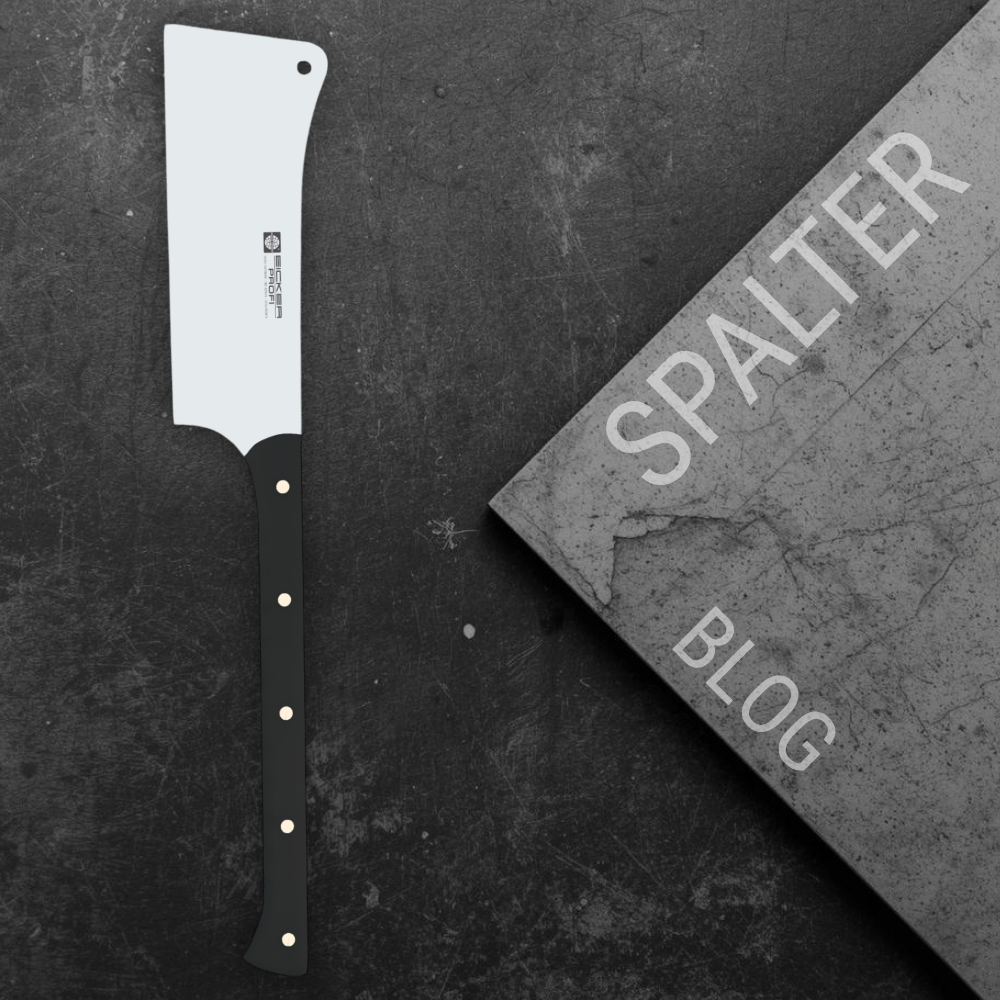
It is important to differentiate between a slaughterhouse cleaver and a artisanal butcher's cleaver for beef. The slaughterhouse cleaver is designed for repetitive blows in quick succession, with a balance point that facilitates the backswing. The artisanal butcher's cleaver is guided more precisely and is suitable for butchering tasks where control is more important than striking speed. If you need specially designed tools, you can find, for example, the EICKER Beef Cleaver for Large Livestock in the JR Versand range.
Medium-heavy cleavers for pork typically weigh between 800 g and 1.3 kg. They combine sufficient mass for reliable blows through pork bones with a balance that allows for fatigue-free work during long shifts. The blade shape is often slightly narrower than that of a beef cleaver, allowing for more precise guidance when portioning.
Anyone who believes that a beef cleaver also works for pork underestimates the difference: the higher weight disproportionately consumes energy during quick, repetitive work on pork halves. Conversely, a light cleaver is simply insufficient for thick beef bones. Both types of animals require the right tool.
For poultry processing and game butchering, compact cleavers weighing significantly less than a kilogram are used. Precision is key here, not raw striking power. Poultry bones are thin and brittle; a model that is too heavy will shatter the meat around the cut instead of cleanly separating it. Nevertheless, the blade must have a specific geometry, as it differs fundamentally from a normal kitchen knife.
Even in game butchering, where different animal sizes and bone structures are encountered, a light, well-guided cleaver is superior to a heavy beef cleaver. Control over the cut determines the yield here.
Poor steel will cost you more than the purchase price: rapid loss of sharpness, chipping at the cutting edge, and in the worst case, breakage under load. In commercial meat processing, choosing the right steel is not a technical subtlety but an economic factor.
Cleavers need different steel than filleting knives. Where a filleting knife is designed for maximum hardness and razor sharpness, a meat cleaver must primarily be tough: it must absorb blows without breaking or chipping. For commercial models, rust-resistant stainless steels like 1.4034 (420 equivalent) with a hardness of 55 to 57 HRC have proven effective. They are fine-grained, mechanically resilient, and corrosion-resistant to the moist environment in slaughterhouses.
High-alloy steels like 440C (1.4125) with 58 to 60 HRC offer greater edge retention but are also more brittle under impact. For cleavers that hit hard bones daily, the balanced ratio of toughness and hardness is more important than absolute sharpness performance. Solingen has been a reference for precisely this balance between material quality and craftsmanship for generations, a regional artisanal tradition with a solid reputation in the industry.
A cleaver's blade geometry determines its suitability for everyday use more than the steel alone. In practice, a convex grind is considered more robust when contacting bone than a flat grind, which cuts sharper but can chip more easily with hard materials. Experienced butchers therefore generally recommend a convex grind for beef bones; for finer cuts on pork, a slightly flatter grind may be more sensible, which you should discuss with your tool supplier if in doubt.
The blade thickness behind the cutting edge is another critical point. A blade that is too thin will break when it hits bone, while one that is too thick will get stuck in the material and transmit force inefficiently. A proven operational rule of thumb is: wide rectangular blades for beef and large livestock, narrower blade shapes for pork and poultry. This guidance covers most decisions in the operation.
A cleaver's weight is not a quality feature in itself. It is a tool parameter that must match the task. Many businesses buy models that are too heavy, believing them to be more professional, and pay for this with muscle fatigue and an increased error rate at the end of the shift.
Heavy cleavers utilize the inertia of the blow. The blade block falls with its own weight, and the butcher has to exert less active force. However, the backswing costs energy: hundreds of times daily. Lighter models cause less fatigue but require more active force in the blow itself, which becomes a problem with hard bones.
As a practical recommendation: the center of gravity of a cleaver should ideally be in the front third of the blade. If it is too far back, the tool feels controllable during the blow but loses penetrating power. If it is too far forward, it is difficult to control during the backswing. A simple test before buying: hold the cleaver by the handle in balance, without swinging it. Where it "hangs" is its center of gravity; this point should clearly be in front of the middle of the handle.
The following weight ranges are considered rough practical guidelines: poultry and small game under 700 g, pork and medium-sized animals 800 g to 1.2 kg, beef and large livestock from 1.5 kg upwards. These guidelines are not rigid boundaries, but they significantly help with initial pre-selection. Anyone who cleaves for several hours daily should look for models at the lower end of the respective weight class rather than the upper end.
Ergonomics are not a luxury feature, but workplace safety. According to DGUV Rule 110-011, hand knives and tools such as cleavers and axes cause 30 to 40 percent of all reportable accidents in the meat industry. An incorrectly chosen tool directly contributes to this statistic. Models designed for continuous use can be recognized by their well-thought-out handle geometry, balanced center of gravity, and materials that prevent slipping in the hand even after hours.
In slaughterhouses and butcher shops, hygiene requirements are not a formality. They are a legal obligation and a direct component of HACCP documentation. The handle material of a meat cleaver is one of the most frequently underestimated points during purchase. Further information on hygiene guidelines can be found in the official HACCP guidelines.
In commercial meat operations, wooden handles are not permitted. Wood is porous, absorbs moisture, and provides ideal conditions for bacteria. Approved materials include plastics such as polypropylene or rubber coatings that can be sterilized at up to 150 degrees and have no cracks or pores. A closed rivet construction is also crucial: transitions between the blade and handle must be gap-free to prevent meat juices from penetrating.
The handle color is not an aesthetic detail but part of the operational hygiene concept. The internationally standard color-coding system according to HACCP clearly separates areas: red for red meat, yellow for poultry, blue for fish. Consistently implementing this system structurally reduces cross-contamination risks, not just on paper.
The question of dishwasher suitability is absolutely practically relevant in everyday operations. Not all models can withstand the mechanical stress and aggressive cleaning agents in continuous use. Stainless steels based on 1.4034 or 1.4125 offer the necessary resistance to disinfectants, according to manufacturers, while cheaper carbon steels quickly tend to corrode in moist environments.
Daily care after use does not have to be elaborate, but it makes a huge difference: clean the blade immediately, wipe it dry, and inspect it briefly. Leaving the cleaver moist in the drawer risks rust spots that increase hygiene risk and structurally weaken the blade. Two minutes of daily routine extend the tool's lifespan by years.
Anyone familiar with the previous sections has the necessary background knowledge. Now it's about the concrete decision, and that always starts with the daily task, not the catalog.
First, ask yourself: Which animal, how many pieces per shift, which bone type dominates? An artisanal butcher shop that processes ten pork halves daily has different requirements than a slaughterhouse with an assembly line operation. In the artisanal butcher shop, precision and versatility are important; in industrial operations, stability and consistent performance over many hours are paramount.
The workload directly determines how much emphasis you need to place on ergonomics and blade edge retention. For occasional use, a solid mid-range model may suffice. For daily continuous use, investing in a high-quality brand tool that performs as well after two years as it did on the first day is worthwhile.
When first holding it, a good cleaver reveals a lot: the grind pattern of the blade must be even, without visible scratches or irregular angles. The handle must be firm and have no gap to the blade. The weight distribution feels balanced, not wobbly. These points can be checked in a minute and are more reliable quality indicators than advertising promises.
Brand origin is not marketing, but a real quality signal. Established manufacturers from Solingen with a long tradition in knife production stand for documented quality standards and transparent material selection. A cheap model that is dull and chipped after three months ends up costing more than a high-quality cleaver that lasts ten years.
The most widespread mistake is believing in the all-rounder: a single cleaver for beef, pork, and poultry. A tool that works equally well for all three areas does not exist in practice. Those who buy a compromise will not have the right tool for any of the tasks. Two specialized models are always better than a half-hearted middle ground.
Hardly less common is overestimating weight: heavy models look more professional but are simply the wrong tool for the wrong task. With handle material, some businesses opt for hygienically unsuitable models because the price is right. This saving effect will be expensively paid back in the next operational audit or food inspection.
A dull cleaver is more dangerous than a sharp one. This sounds counterintuitive but is a recurring cause of accidents, expressly documented by the DGUV publication on occupational safety. Dull blades require more force, guidance becomes less precise, and uncontrolled slipping is the result. Regular sharpening is therefore not maintenance, but active occupational safety.
DGUV Rule 110-011 stipulates clear requirements for protective equipment in slaughterhouses and butcher shops: cut-resistant gloves and suitable footwear during the cleaving process are mandatory, not optional. This applies to every employee who regularly works with cleavers and axes. Those who take the obligation of risk assessment seriously also regularly document tool condition and protective equipment.
A professional meat cleaver is an investment. With proper care, it stays in top condition for years; without care, it quickly loses sharpness and structural integrity.
Cleavers have different sharpening requirements than filleting knives. They don't need razor sharpness, but a robust, tough cutting edge that can withstand impact. The honing steel is the right tool for daily care after use: 10 to 15 strokes per side with light pressure straighten the steel and maintain edge retention. For regularly sharpened cleavers, the honing steel is sufficient for a long time.
If the blade is dull and the honing steel is no longer sufficient, the sharpening stone is used. For cleaver blades, a sharpening angle of 15 to 20 degrees is maintained with even pressure and a wet stone. Start with a coarse grit for rough sharpening and switch to a fine grit for polishing. Overheating due to too much pressure or too dry work permanently destroys the blade's hardness.
Cleavers lying loosely in drawers or on worktops suffer from two problems: the blade dulls through contact with other tools, and it creates a safety risk for anyone reaching into the drawer. Magnetic strips or blade guards are the simplest solution for structured storage during operation.
A visual inspection before each use should become a fixed routine. Chipping, hairline cracks, and corrosion spots are the most important warning signs. A cleaver with a hairline crack in the blade must be discarded immediately, regardless of how new or expensive it is. This is not a cost-saving decision, but rather complies with the requirements for occupational safety and risk assessment according to DGUV standards. A damaged tool is more dangerous than none at all.
Good advice doesn't end with theory. The question is: Where can you find the discussed requirements in a concrete, tested assortment?
JR Versand is a specialized dealer for the meat processing industry, based in Solingen, the city that has been synonymous with blade quality for over a century. The product range includes professional cleavers and butcher's choppers from established manufacturers who produce knives and cleavers for commercial users in butcher shops, slaughterhouses, and the meat processing industry. What this concretely means: Every product in the range is designed for the requirements of this industry, not for the leisure market. In addition to cleavers, JR Versand also offers professional slaughter knives for daily use.
The product range principle at JR Versand is practice-oriented: Professional cleavers, precisely fitting sharpening accessories, and certified protective equipment all come from one source. When choosing a new cleaver, JR Versand not only offers the optimal sharpening steel and sharpening stone for resharpening, but also the prescribed cut-resistant gloves. For demanding applications, JR Versand also offers high-quality knives such as the SICO ERGOLINE II.
The difference between a specialized dealer and a general online marketplace quickly becomes apparent in practice. At JR Versand, commercial customers receive product knowledge that goes beyond technical data sheets, guidance on HACCP and DGUV-relevant products, and reliable availability for businesses with regular needs. For slaughterhouses and meat processing companies with larger order quantities, B2B conditions and consulting services are available that address specific operational requirements.
Those looking for the right cleaver for their business will find a sorted, professionally sound selection at JR Versand, without having to go through platforms unrelated to the industry. The range is not the broadest on the market, but it is consistently geared towards the meat processing industry.
When buying a cleaver, you are simultaneously deciding on the animal species and application area, blade quality and material selection, as well as hygiene safety and compliance in the operation. Those who correctly assess all three axes make the right choice once instead of the wrong one twice.
The most important change in perspective is this: A meat cleaver is not a consumable item, but an investment. Those who treat it as such, choose it correctly, maintain it regularly, and resharpen it immediately when the blade is dull, will have a safe, high-performance tool in their hand for years. Those who buy it as a disposable item pay for it with a loss of quality, increased risk of accidents, and unnecessary follow-up costs.
For professional cleavers with solid expertise behind the product range, JR Versand in Solingen is the right point of contact. The offer is geared towards the specific requirements of butcher shops, slaughterhouses, and the meat processing industry, including sharpening accessories and protective equipment. Find out more now and find the right cleaver for your business.
Share:
Buying a boning knife: What pros look for
Whetsteel Buying Guide: The Best Models for Butchers & Chefs